
MKSP 2026 Star Party Information
August 3, 2026
Announcing:
Cancellation of MKSP 2026
Following a decision made in the last 48 hours, MKSP 2026 has been cancelled due to the smoke and wildfire threat in southern British Columbia. We deeply regret the need for this last-minute decision.
Organizers have tried to keep hope for a successful event alive even as the situation has deteriorated, and have been working to make our star party happen right up until this holiday weekend. But new fires in the region are breaking out almost daily, and smoke from the more remote fires is blowing in more frequently and more thickly. A major fire in Washington State is directly visible on Kobau’s southern horizon, and its smoke plume is compromising the most coveted part of the Canadian summer night sky – the low south, particularly the Sagittarius Milky Way. Our primary concerns for the safety of our attendees and their ability to truly enjoy clear, dark skies have won out over our latent optimism. We feel there is no reasonable option but to cancel.
We know this will cause great inconvenience and disappointment to our fellow hobbyists who have been planning and packing to attend MKSP, and we hope the decision has not come too late for you to make something valuable of the time you would have spent at Mt. Kobau. If you have pre-registered, we will refund your fees.
Please note that outside of MKSP -- now cancelled for 2026 -- the star party site is a Protected Area where overnight camping is not allowed.
There’s little upside to this turn of events, but for some of you, it may be an option to attend a September event put on by amateurs in the Kelowna area – the Okanagan Observatory Star Party. For more information on that event, September 10-14, contact our Registrar, Colleen O’Hare, at chohare0@gmail.com
- Organizers of the Mt. Kobau Star Party
MKSP 2026 - President's Message
April 20, 2026
Hello kindred astronomy enthusiasts,
There is still a cap of wintertime snow atop Mt. Kobau, but plans are well underway for MKSP 2026!
With a legitimate claim to being the longest-established regional star party in Western Canada, MKSP turns 42 this year. The summit of 1870 metre Kobau (Tx̌asqn to local indigenous peoples) was chosen by organizers based on its reputation as Canada’s best location for optical astronomy – so designated in a mid-20th Century survey to select a site for a proposed telescope which would have been second in size to Palomar’s renowned Hale reflector. Few remnants of the cancelled Mt. Kobau Observatory project remain on the summit, and the darkness of Kobau skies can no longer claim to be world-class, but the site still provides extraordinary views of deep-sky wonders and frequently yields the combination of rural-class skies and superb steadiness that observers and imagers rarely get at home.
Sky highlights for 2026 include the magnificent arch of the Milky Way with all its treasures, the superior planets Saturn, Mars and the distant ice-giants Uranus and Neptune. Best of all, this year’s event is centred on the peak of the Perseid Meteor shower – we’ll have tips on how to get the most out of meteor observing.
As always, MKSP provides the opportunity to share experiences, take on observing challenges, enter imaging and ATM contests, buy souvenir merch, and attend talks – this year covering topics ranging from the history of Radio Astronomy to pioneer rocketry. Make plans now to join us!
MKSP 2026 begins at dusk August 8th, and ends at dawn, August 16th.
I hope you’re able to join us on the mountain. If you’d like more information including how to contact us you will find it here.
Jim Failes / Mount Kobau Astronomical Society
MKSP 2026 Skies
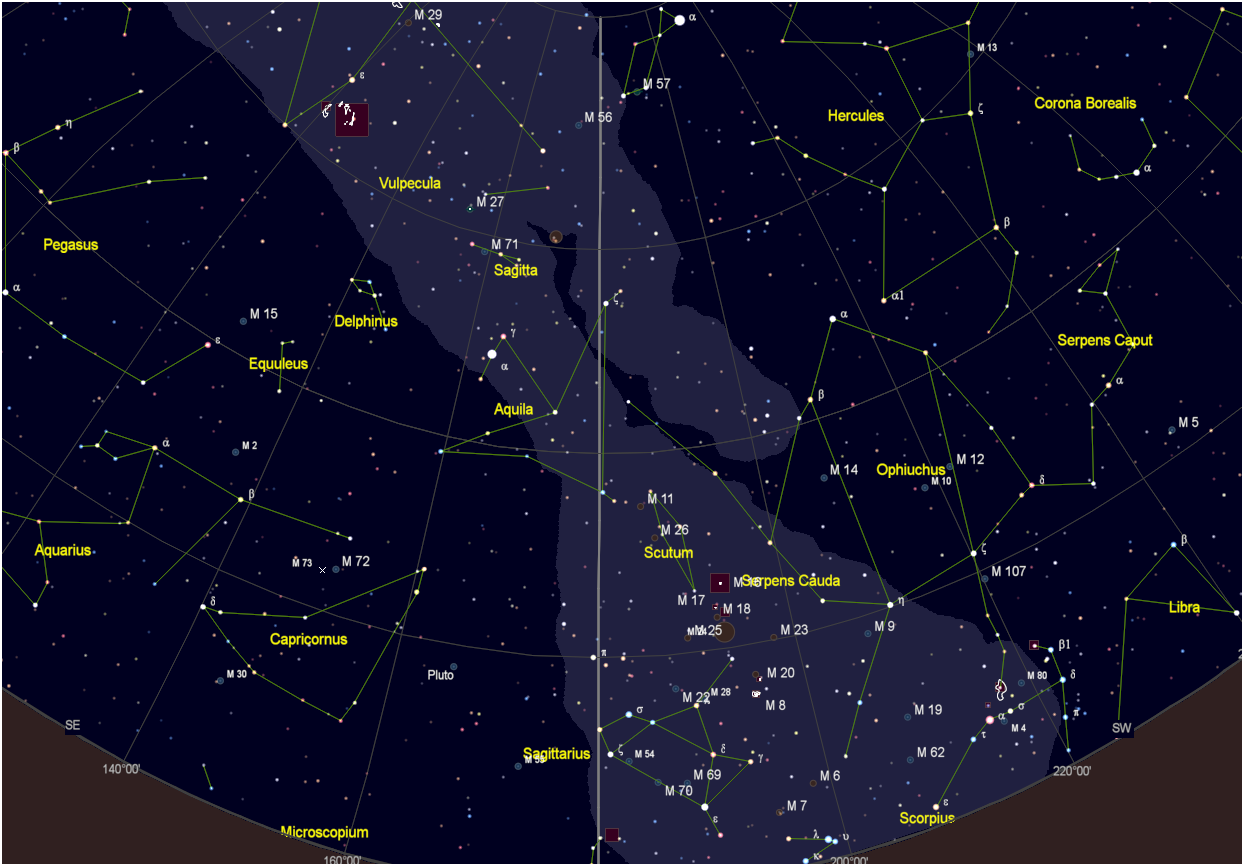
For MKSP 2026 Skies, click on the image below to learn more about what you will be able to see this year.
Registration Information
Pre-registration is Preferred for the 2026 MKSP-Mt. Kobau Star Party. Sorry, it is not possible to for us to reserve space on the mountain top.
Pre-Registrations can be mailed to us as soon as they are filled out, with payment by cheque or money order enclosed. If you choose not to pre-register, you can register on-site.
The Rates for MKSP 2026 are the same as last year see the table below.
A form to register by clicking on the Reg. Form button below to obtain/print a copy.
Payable by cheque or money order in Canadian Funds.
Make cheques payable to: Mount Kobau Astronomical Society. Mail to: MKSP Registrar, 1069 Calmels Crescent, Kelowna, BC, V1Y 4L6
Download 2026 Pre-Registration fillable form
| Number in Party | Number of Nights | Fee |
|---|---|---|
| One person | One night | $25.00 |
| One person | Two nights | $50.00 |
| One person | More than two nights | $75.00 |
| Two or more persons | One night | $35.00 |
| Two or more persons | Two nights | $70.00 |
| Two or more persons | More than two nights | $100.00 |
MKSP 2026 Schedule of Events
Talks may be postponed in the event of bad weather. Times here are tentative. Check at the Registration Desk for the most current information.
| Date | Event |
|---|---|
| Saturday, Aug. 8 | MKSP begins at dusk. |
| Sunday, Aug. 9 | 1:18 am – Moonrise 2:00 - 4:00 pm – Registration |
| Monday, Aug. 10 | 2:00 - 4:00 pm – Registration 8:15 pm @ The Flats – Speaker: Peter Balholm Topic: Pedro Paulet, Rocket Pioneer |
| Tuesday, Aug. 11 | 4:04 am – Moonrise 2:00 - 4:00 pm – Registration |
| Wednesday, Aug. 12 | New Moon (not observable) 2:00 - 4:00 pm – Registration 3:00 pm @ The Flats – Speaker: Ken Hewitt-White Topic: Kobau Skies this Week |
| Thursday, Aug. 13 | 8:43 pm – Moonset (Probably not observable) 2:00 - 4:00 pm – Registration 8:15 pm @ The Flats – Speaker: To be announced 10:00 pm @ The Flats – Binocular Star Walk Guide: Mark Force - Alternate time |
| Friday, Aug. 14 | 8:59 pm – Moonset 2:00 - 4:00 pm – Registration 8:15 pm @ The Flats – Speaker: Dr. Roland Kothes of DRAO Topic: A History of Radio Astronomy 10:00 pm @ The Flats – Binocular Star Walk Guide: Mark Force - Alternate time |
| Saturday, Aug. 15 | 9:13 pm – Moonset 2:00 - 3:00 pm – Registration Morning to 3:00 pm – ATM Contest Judging Walkabout Time & Meeting to be posted 3:00 pm @ The Flats – Closing Ceremonies, Door Prize Draw, Group Photo 5:00 pm @ The Flats – Swap Table |
| Sunday, Aug. 16 | MKSP ends at Dawn Partygoers pack-up and leave once they are fully rested. |
Talks and Speakers

Peter Balholm
THE LIQUID-FUEL ROCKET IN 1901: THE STORY OF PEDRO PAULET
Pedro Paulet was a Peruvian college student who built the world's first liquid-fuel rocket engine in Paris about 1901. This talk compares and contrasts him with Robert Goddard, looks into the plausibility of his never-built rocket plane, debunks a few modern myths about him, and explores his connections with people in astronomy and science fiction, including William Pickering and H. G. Wells.
Bio:
Peter Balholm has been watching the stars since 1997 and attending MKSP since 2016. Because his love for astronomy is many-branching, he has also spent these years both building a variety of telescopes and digging deep into the history of astronomy. He is currently writing a "hard" steampunk alternative-history novel starring real-life astronomers like Camille Flammarion, Robert Burnham, Jr., and John Dobson. Among its more-obscure characters is the Peruvian rocket pioneer (and subject of his speech this year), Pedro Paulet. Peter has never seen a "canal" on Mars, but would very much like to do so someday.
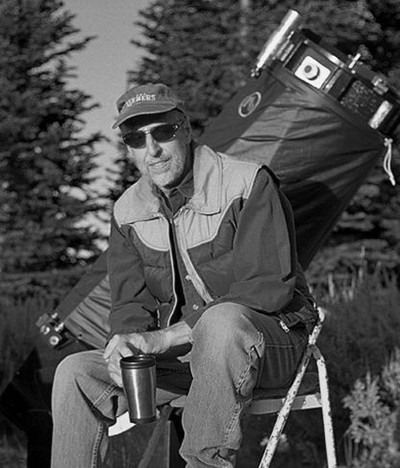
Ken Hewitt-White
KOBAU SKIES THIS WEEK: PERSEID METEOR OBSERVING
Our dark skies are ideal for taking in the Perseid meteor shower, which reaches its peak activity Thursday/August 13. Join veteran observer and meteor-lover Ken Hewitt-White Wednesday afternoon and learn how to get the most out of your Perseid watch. Ken will report on how activity is ramping up, tell us the finer points of what to look for, and recount some of his best Perseid memories.
Bio:
An incurable deep-sky observer, Ken has been enjoying the dark skies of Mt. Kobau since the mid-1970s. He is a contributing editor for Sky & Telescope magazine and is the editor of several astronomy books. Most recently, Ken co-authored the 5th edition of Terence Dickinson’s venerable stargazing book NightWatch.
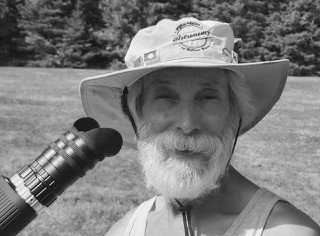
Mark Force
BINOCULAR STAR WALK
Bring your binoculars and a blanket to lie down on as you join veteran star-walker Mark Force for a guided tour of the sparkling Mt. Kobau Sky. His tour will lead you across the heavens with stops at star clusters, nebulas and galaxies – the very best binocular highlights of summer. The star walk is a perennial Kobau favourite. Don’t miss it!
Bio:
With traditional host Murray Paulson eclipse-chasing in Spain, we’re thrilled to have the inimitable Mark Force as your 2026 bino-guide. Mark found astronomy at an early age but later wandered away from it to other hobbies and commitments. (His former home in a light-rich area of Vancouver may deserve much of the blame.) Moving to a dark spot in Peachland in the early 90's got the star fires burning again. Now, when skies are clear and time allows, you'll find him in the backyard catching as many photons as possible. The moon is still Mark's first love, but he’s known to fist wave at her when she seems brighter than she should be.

Dr. Roland Kothes.
A HISTORY OF RADIO ASTRONOMY
In this presentation, we will step beyond the limits of optical astronomy and dive into the world of radio waves, exploring the sky in a whole new way. Radio waves penetrate interstellar dust, allowing us to map the invisible universe, study galaxy structures, and investigate dark matter and black holes: they are the tools for solving some of the greatest mysteries of our Cosmos. From the birth of radio astronomy in the early 1930s to the frontiers of modern research, we will explore together what radio observations have taught us so far. This presentation delves deeply into the history, pivotal (though mostly serendipitous) discoveries, technological innovations, and scientific impacts of modern radio astronomy.
Bio:
Dr. Roland Kothes was born in the small town of Süchteln (about the size of Salmon Arm), near Düsseldorf in Western Germany. He received his PhD in 1997 at the Friedrich-Wilhelm-Universität in Bonn, Germany. His thesis was entitled: "Multi-Frequency Studies of Galactic Supernova Remnants with the 100-m Radio Telescope in Effelsberg". Dr. Kothes came to Canada to work on the Canadian Galactic Plane Survey at the Dominion Radio Astrophysical Observatory. In 2008, he was offered a permanent position at the DRAO as a staff radio astronomer and took over the lead of the DRAO science team in 2014. He also trains and mentors graduate students at the University of Alberta, where he is an adjunct professor. His research focuses on the study of supernova remnants, pulsar wind nebulae, and the interstellar magnetic field.
Contests, Pins and Awards
This year as is traditional for MKSP there may be awards for the following. For more information on how you might participate ask when you arrive for more information on how to compete for these awards. The Judging occurs on Saturday Morning, so you have to let us know before then that you want to enter.
IMAGING CATEGORIES
A trophy may be awarded for each of the following categories
Prime Focus
Piggyback
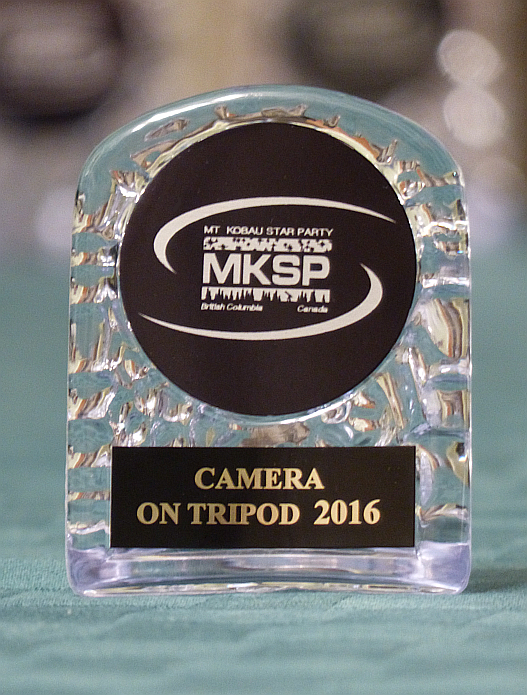
Camera On Tripod
Novice Astrophoto
Daytime Photo
Nature
Video
Exceptional Astrophto
EQUIPMENT MAKING CATEGORIES
A trophy may be awarded for each of the following categories
Mechanical Excellence
Most Innovative Design
First Time Telescope
Dobsonian Telescope
Astronomical Equipment
SKETCHING OR DRAWING CATEGORIES
A trophy may be awarded for each of the following categories
Sketching and Drawing from the Telescope
OBSERVING LISTS
MKSP is pleased to present observing suggestions. The observing program suggestions are not competitions in the true sense of the word but rather are intended to provide the astronomer with a sense of accomplishment. Levels of experience range from absolute beginner to seasoned amateur. Refer to the lists below for details.
Completed lists will be rewarded with a pin and your name will be posted in the History section on the MKSP website for all to see. To obtain a pin, bring your completed form to the registration desk during hours of operation.
You will find all the lists by clicking on the links below. Choose the list or lists you would like to try. You may download a copy then print or you may just print the pdf file(s) directly. Don't forget to bring printed copies for your use at the star party.
- UnAided Eye List: No optical aids except your eyes are required to complete this task. Completion of this list will provide those who have little or even no knowledge with the summer-time night sky a satisfying experience of observing fundamentals.
- Bright Objects List: A pair of binoculars or small telescope will be beneficial to complete this list. The list is intended for the beginning amateur, but even experienced astronomers will gain great satisfaction from finding and viewing these objects.
- Intermediate Objects List: You'll need at least a small aperture but a medium sized telescope is recommended to complete this list. This is the list most MKSP attendees will wish to attempt.
- Challenge List: This is a very difficult list and will require a large aperture telescope to complete. Intended for the experienced astronomer.
Click on the link to download a printable PDF to take to the mountain.
Click on this image to download a pdf list of the Unaided Objects.
Click on this image to download a pdf list of the Intermediate Objects.
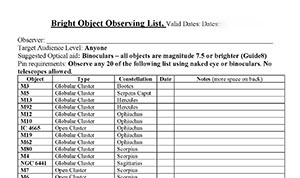
Click on this image to download a pdf list of the Bright Objects.
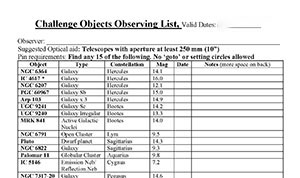
Click on this image to download a pdf list of the Challenge Objects.
MKSP 2026 Recipients' - Contests, Pins and Awards
Awards
A selection of Recipients are presented here
Observing Pins and/or Ribbons
A selection of recipients are presented here.
Raffle Prize
A selection of recipients are presented here.
Door Prizes
A selection of Recipients are presented here